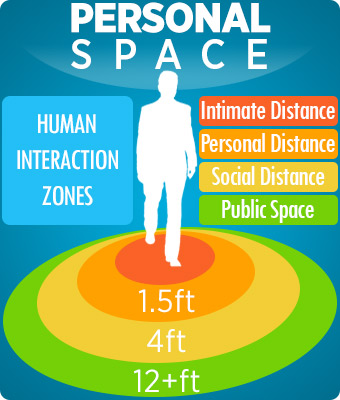
We all have our invisible and protective bubble around us. It´s the space where we feel safe. It´s the personal space that can vary widely from culture to another and can be different from one person to another.
Have you ever seen how the Japanese push passengers into the train and look like sardines in a can?
In Argentina we live similar situations when we travel in a train or a bus in “la hora pico,” (the highest traffic flow schedule) but there are no people pushing others inside the train or a bus. We just have to wait for the next one. Since we live in a polychronic culture, it is not a big problem, except for those who have an obligation to maintain a rigorous schedule. There is not a personal space bubble that counts in those situations, and they have to sacrifice their space to meet their schedule. This is an intercultural similarity. We can see it in all the big cities where there is a high concentration of population. Every country around the world have their own parameters of personal bubble space. A study published in the Journal of Cross-Cultural Psychology says that participants from Argentina, Peru, Bulgaria, Ukraine, and Austria don’t mind if you chill about 90 cm away, or less than three feet.
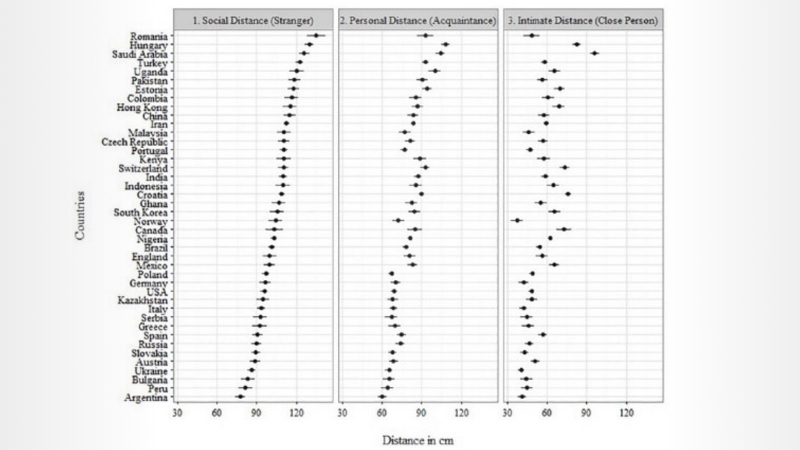
Argentines usually greet each other with a kiss on the cheek, whether he or she is acquainted or is a friend’s acquaintance. This is already a great approach. We are seen as a less affectionate person if we do not do it. And a couple of weeks ago I realized the difference. An American returned missionary came to my ward to visit us, and when I saw her, I gave her a kiss and a little hug in welcome because I was really excited. She remained motionless, and not knowing what to do. That´s when I remembered the differences in our bubble space. I imagine she was felt like me when an Italian woman greeted me with two kisses a couple of years ago. It was too much for me, but I respected her way of greeting me. Each one of us has their own personal space bubble based on her or his own cultural paradigms and personal experiences.
In Germany for example, personal space is sacred. In England, overheard a conversation is rudeness synonym, while American people do not care about it.
In http://westsidetoastmasters.com/resources/book_of_body_language/chap9.html there is a good article about other factors of distance zones: Rural vs. City Spatial Zones, Territory and ownership, and the territorial rights of the car.
We must be aware of personal space differences because cultures and persons have their own paradigms. This can cause misunderstanding. In an ESL classroom, we can find students from different places and cultures. In order of getting to know them, we need to observe and respect their parameters. One important thing we must do is model good personal space in order to establish a norm of self-respect and respect others.
“Personal Space is a very important social skill for children in elementary school to learn, practice, and grow. Understanding and keeping good personal space helps children to engage more successfully in everyday interactions and in personal relationships with peers and adults, as well as helping them to stay safe.” (3 Key Points When Teaching Your Students about Personal Space, Socially Skilled Kids)
References
- Journal of Cross-Cultural Psychology https://journals.sagepub.com/doi/abs/10.1177/0022022117698039
- 3 Key Points When Teaching Your Students about Personal Space, Socially Skilled Kids.

 TESOL Certificate
I am always so appreciative for the different cultural perspectives you are able to teach us, Yael! Thank you so much!
LikeLiked by 1 person
Thanks for the insights! I served my mission in Japan, which is very monochromatic. Everything must be on time! So, they pack on as tight as they can.
LikeLiked by 1 person