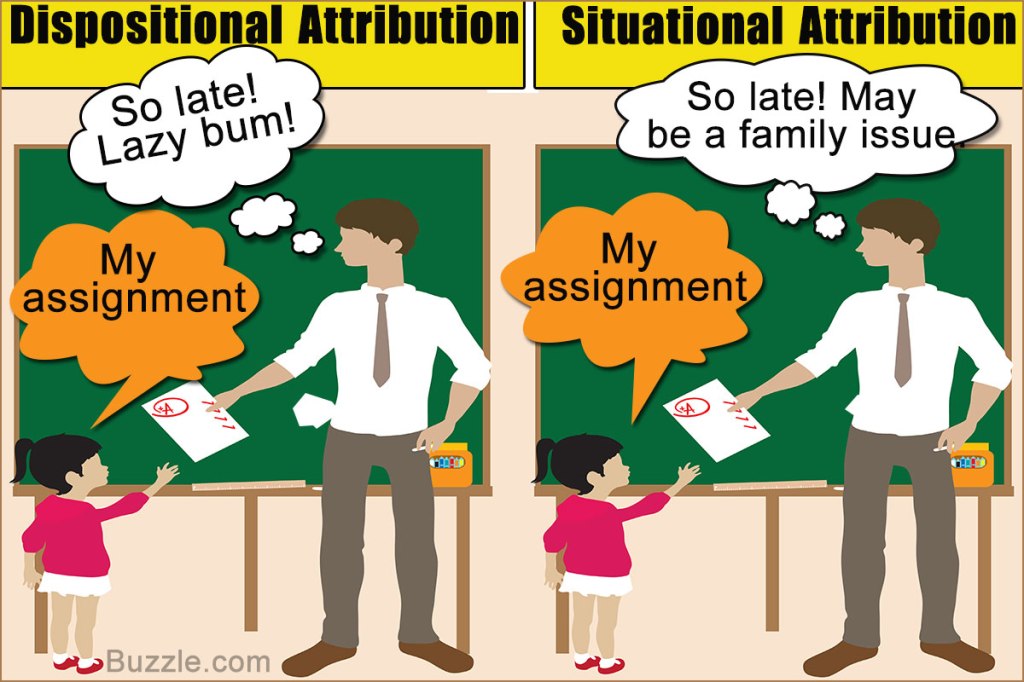
Attributions are inferences that people draw about the cause of events, others’ behavior, and their own behavior.
It´s a very complex and personal condition. Every one of us tends to justify the consequences of his or her actions and blaming others or blaming himself.
There are two dimensions of attributions: External and internal, and stable and unstable.
External vs. Internal
Example: Maria’s car breaks down on the freeway. If she believes the breakdown happened because of her ignorance about cars, she is making an internal attribution. If she believes that the breakdown happened because her car is old, she is making an external attribution.
Stable vs. unstable
Example: Lee gets a D on his sociology term paper. If he attributes the grade to the fact that he always has bad luck, he is making a stable attribution. If he attributes the grade to the fact that he didn’t have much time to study that week, he is making an unstable attribution ( https://wattersattribution.wordpress.com/)
When I watched Attributional tendencies in cultures video, I realized how complex we are. If we are religious, we tend to attribute to God our failures and successes because they are part of our earthly life. The reason we are here is to grow spiritually and show obedience, but sometimes we tend to attribute to God all the things that happen to us. If we fail, we can attribute it both internally and externally. Internally when we feel that we are not worthy enough, or that we are sinners. Externally when we say that God punishes us. As Prof Ivers says, “Every circumstance is different.”
What misunderstandings and problems could potentially surface in the TESOL classroom?
Each of us has its own spiritual fragility and different ways of seeing the same reality. Some of us tend to justify failures and successes in internal stable/unstable attribution or external stable/ unstable attributions. Depending on the culture, students may have different attributions styles. People in collectivist cultures tend to be less susceptible to the tendency to attribute other people’s behavior to internal factors such as personality traits, abilities, and feelings (Fundamental Attribution Error) than people in individualist cultures. People from collectivist cultures are more likely to believe that a person’s behavior is due to situational demands rather than to personal attributes. People from collectivist cultures are also less susceptible to the self-serving bias (the tendency to attribute successes to internal factors and failures to situational factors.)
Prof Ivers told that in Japan, the typical Japanese person will attribute personal successes externally. “The reason I am successful is because of my parents, my great teachers, and so on.” But he or she will attribute personal failures internally. Every time they fail, it’s their fault, it’s always their fault. And Japan has a high suicide rate.
I remember an experience that makes me realize the importance of knowing our students and the tendency we have to attribute failure internally or externally.
I had a peer who every time she failed her English exams, she immediately cried. She was crying once and told the professor why she was failed. She told him about the problems that she had had during the week for which she had not been able to study for the test and that she was totally responsible for not knowing how to handle the circumstances. She attributed the result to external circumstances, but she felt guilty. The professor must be prepared to face psychological situations like this.
I agree with Prof. Ivers when he says that every circumstance is different. We can be rational and evaluate each situation objectively. As teachers of an ESL class, we must be prepared to handle situations in which students have different susceptibilities, and attribute his or his failures and successes differently. We also must to analize student´s performance objectively in order to avoid wrong expectations and attributions.
Here is a good explanatory video:
https://study.com/academy/lesson/teacher-expectations-attributions.html
References
- John Ivers, Attributional tendencies in cultures video.
https://video.byui.edu/media/05+Attributional+Tendencies+in+Cultures/0_u45682wd
- Attribution processes article.
https://wattersattribution.wordpress.com/
- Social psychology summary, SparkNotes
https://www.sparknotes.com/psychology/psych101/socialpsychology/section3/ ; \lsdp

 TESOL Certificate
Your post is perfect. I liked the way you explained the attributions. As professor Ivers said every circumstance is different and we, as instructors will face many situations that can wrongly be judged if we are not aware of these concepts.
LikeLike
Thank you very much for your insights.
LikeLike