“Exposure to cultural diversity may force children (or even adults) to form new neural connections in the brain to be able to sufficiently interpret meaning in things to which they are not accustomed.” (Ivers)
The study of culture in the classroom is very important. Each culture has its own paradigms and ways of seeing the same reality. Research has shown that “people exposure to other cultures generates new neural connections may be at one’s permanent disposal to assist in a myriad of potential cognitive processes such as language processing, knowledge acquirement, formal operational and dialectical thinking, problem-solving.”(Ivers)
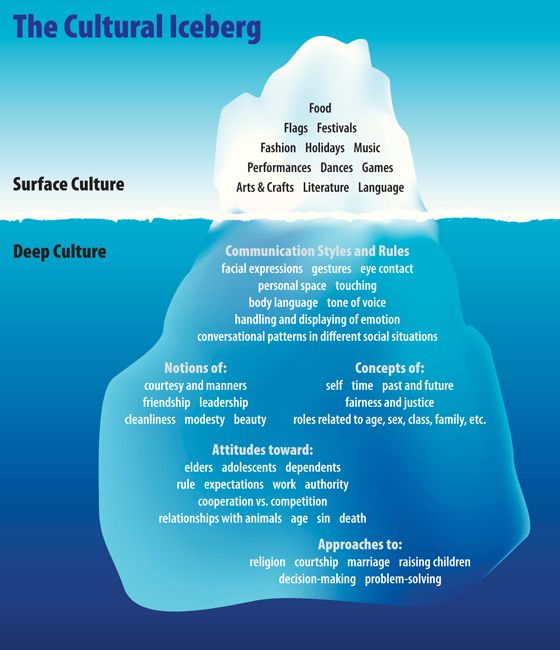
When we refer to culture, in general, it comes to mind to drink mate in Argentina, the celebration of Halloween or the way in which the Japanese greet each other. However, we can deepen and realize that culture is not just about the visible actions we do, the festivities we celebrate, or the stories of national heroes. These are the tip of the iceberg. They are only the small and visible part. 90 percent of an iceberg is below the surface and is not visible. In recent weeks, we have learned about cultural manners, collectivist versus individualistic societies, polychronic and monochronic cultures, degrees of emotional expressiveness in cultures, etc. “Underwater” we can find many psychological factors that influence people´s behavior from different cultures, direct the ways in which we see the reality that surrounds us and can limit understanding between people from two different cultures.
As we can see, culture has a profound impact on us. It is an important topic to address in the classroom. It is a great challenge to deepen the culture, but we can teach it from the first grades. As age increases, the teaching can be deeper. For example, a good way for children to learn about different cultures is to look for the customs of the ancestors (our grandparents always have a good story to tell us) or family members who live in another culture. My husband’s grandfather was Japanese, and inherited from him the collectivist point of view, respect for adults and thanks for the food. Not in the same way, because he belched and said a few Japanese words later, but the feeling of gratitude. My grand-grand fathers were Italian. I inherit from them the importance of the family union.
As Ivers &Ivers advise, “One should probably begin with cross-cultural information that is not extremely complex, but yet it drives home the idea of diverse interpretations.” Personal experiences are always beneficial because we can catch the student´s attention, and we can discuss different points of view of the same experience.
“Here are a few examples, and again, we don’t see the need to have the cultural items be exclusively target culture phenomena:
- One that might be in this realm would be the diverse interpretations of gestures.
- Manners can also provide an area where simple yet diverse interpretations can be taught.
- Discussing intensity and expressivity levels from one culture to another may push the limit on keeping it simple but we still think it can be accomplished with a modicum of success.
- Stories of personal experiences with other cultures are beneficial for several reasons. First of all, they are extremely helpful in maintaining attention. If the students are not attending to what you say, it will matter little how adroitly you say it. Second, by cautiously discussing some of your personal experiences (or those of an acquaintance) you may be able to somehow work in the idea of diverse interpretations of reality. Third, even if you are unsuccessful in touching the deeper, interpretive realm, any discussion of foreign culture is usually valuable.”( Ivers &Ivers)
As educators, we can go deeper into the culture. If we allow our students to see different ways of facing the same reality, they can better understand the psychological reasons why people behave in different ways, will be more tolerant of others and will reduce prejudice and the image of superiority. We can take into account this formula:
A. Event or circumstance …….. B. Beliefs (or culture)…….. C. Reaction (Albert Ellis (2001))
References
Cultural Diversity Creative Genius Cognitive Development: Teaching Deeper Culture in Elementary School Foreign Language Classes, Ivers& Ivers.

 TESOL Certificate
What a great post, I believe that as instructors we can be good examples for our students, so we first, we have to learn all that is possible about other cultures to understand them better and help them understand each other.
LikeLike
What a great eye opener this Is. Culture awareness Is to feel how they feel by interpreting things as they do. Great post.
LikeLike